Thursday, 4 February 2016

Gender Representation in the 1980s


Women's Identity

Women in working environments were increasingly being represented through the media in the 1980s. The views on women's roles were shifting from expecting women to stay at home, to being supportive of those who wanted a place in the business world.  

Working girl was a film released in 1988 about a women named Tess who works her way up the job ladder, encountering issues on the way because of her gender. This film represents a powerful message that women in this time do have a place in businesses and that they can work to the same level that men do. Although it also shows the struggles that have to be overcome in order to get to this place. 

The character of Tess shows some of the problems with being female in a male dominated work force. At the beginning of the movie, she find herself in a position where her male co-workers treat her as a sex object, not seeing her as an equal employee. This issue holds her career back and she feels that the only way she will get to her goals of becoming a successful business women is to find a new job. Tess then starts to work for a powerful woman, Kate who manipulates her and uses her for her clever ideas. This is until Kate breaks her leg in a skiing accident and Tess has the opportunity to pose as an executive and experience life as a successful woman. 

The reaction to Working Girl was very positive when it was first released, with film critics such as Roger Ebert rating it four out of four stars. This was important as it shows that the idea of working women was happily received and accepted in society at this time. 

When looking back on this film today, it is clear to notice the obstacles that women had to overcome in order to be in a good position in the working world. These things are less of an issue today although that is not to say that there is still not gender bias around. We can definitely observe a progression from the 1980s to the present day with how working women are treated and their experiences in the job. 


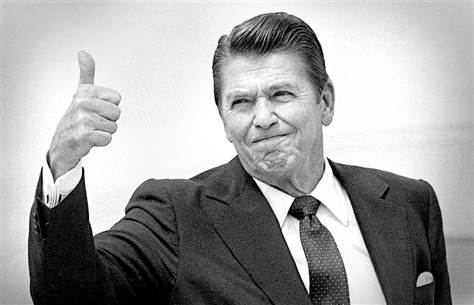
Reagan vs. Race

Reagan held his presidency throughout much of the 1980's therefore it is only fair that he should be discussed in relation to his influence on race and minority groups throughout the decade. In general President Reagan never said he would support and help minority groups and instead stated that his presidency would give indirect benefits to such minorities. Due to this Reagan never supported minorities and financial aid was significantly reduced meaning that the eighties was a very difficult time for many minority peoples.

Native Americans
Native Americans at this time were still suffering from severe discrimination and were still frantically fighting the government for land which they felt had been unjustly taken from them. Reagan did little for their cause and was set on cutting federal spending given to the Bureau of Indian Affairs, this left many Natives homeless and in severe poverty. The land disputes of the eighties often led to the government stripping the people of even more land instead of granting them what they were duely owed. In 1980 however a Supreme Court ruling over the United States vs. Sioux Nation of Indians ruled that in fact the United States had illegally seized land and owed the Sioux nation over half a billions dollars worth of reparations. Finally, one beneficial aspect that even stands today from the Reagan presidency is that he wrote in he Indian Gaming Regulatory Act, allowing gambling on Native American land, thus boosting the economies of many tribes.

African Americans
Discrimination towards black Americans was still rife within 1980's America. Civil rights had been passed only 15 years ago at this point and many WASP's still didn't appreciate the black population. Reagan refused to fund any civil rights campaigns and instead argued that his boosting the economy would in turn support these campaigns. Reaganomics however completely failed in supporting minorities and the lower classes and instead left many people, particularly African Americans impoverished. This did not stop the progression of black people into lower level politics, by the late eighties many African Americans were mayors, on education boards and other lower level yet still influential positions. In 1989 this all changed, when President George Bush took office he valued African Americans and appointed a number of minorities into higher governmental positions. Just as this progress into government happened, a progression into culture erupted as well. Such people as Michael Jackson, Queen Latifah, Magic Johnson and Jesse Jackson all began their influence on culture that even today still resonates.

Source; https://sites.google.com/a/micds.org/american-race-and-racism-1970-to-present/home/19
Image: http://www.stuckindc.com/wp-content/uploads/2015/09/rr.jpg

Wednesday, 3 February 2016

Miami - a decade of racial tension


 Civil Rights became one of the pivotal aspects of American culture during the 1960s following the implementation of the Civil Rights Act 1964.  It continued as a key issue throughout the 1970s. As the 1980s loomed, many hoped that the new age of racial equality had dawned, and racial injustices such as the principal of ‘separate but equal’ in American law were past.  In reality, the 1980s saw riots, serial murders, muggings, kidnappings, rapes and murders as constant examples of the continuing racial tensions across a divided America.
  Whilst racism was rife throughout the whole of America, in Miami, a city with a high percentage of black people of whom many already lived in poverty stricken circumstances, two episodes of civil unrest as a result of perceived racial inequality served as bookends to the decade and highlight the little progress towards true equality that was made during the period.
  In April and May 1980, six white police officers were acquitted by an all-white jury in a case of horrific brutality that resulted in the death of Arthur McDuffie, a black father of two who was riding a motorcycle with a suspended licence. Four of the officers had chased and then beaten McDuffie into a coma whilst he was handcuffed and on the ground, and subsequently lied and falsified evidence, with the assistance of two other police officers.  Their acquittal was seen as evidence of institutionalised racism and Miami became the backdrop to some of the worst rioting American had witnessed since the Civil Rights movement had taken hold in the 1960s.  Over the course of four days, eighteen people were killed, three hundred and fifty were seriously injured, and eight hundred arrests had been made, as well as damage and destruction to the city amounting to $100 million.  Many parts of the city had literally been burnt to the ground, and the levels of destruction and violence during the rioting were such that they are still shocking today, for example, with instances of people being deliberately locked into burning cars.  
  Miami never really recovered.  Three thousand jobs were lost as a direct result of the riots.  Whilst federal financial assistance was given, it was nowhere near enough for the city to rebuild.  Miami spiralled into decline, and thousands of its citizens moved away, adding to the difficulties the city already faced in trying to start afresh. 
  In January, 1989, just as the city was preparing to host the Superbowl, an event which was to signal new beginnings and draw a line under its difficult past, the city saw yet another spate of rioting which began following an eery reflection of the events of 1980.  On this occasion, it was the death of two young black men, 34 year old motorcyclist, Clement Lloyd and his passenger, Allan Blanchard, at the hands of an Hispanic Miami police officer, William Lozano, who was following Lloyd because of an alleged traffic violation, which served as the catalyst to rioting throughout the city.  With many press agencies already in town in preparation for the Superbowl, the event quickly made national and international news, and yet again the world woke to images of Miami with burning press vehicles and buildings serving as a backdrop to yet more pictures of looting and violence. Following the deaths, a federal Civil Rights investigation was launched to answer the question of why a black man had been shot dead for speeding, and manslaughter charges were brought against Lozano.  In this first trial, Lozano was convicted of the men's manslaughter, however the FBI's efforts were short-lived because the conviction was overturned on appeal with Lozano having served no time in prison.  
  The Lozano case also left a very significant legacy which would almost certainly impact on the future of American justice in such cases, and perhaps speaks to the question of why, in the twenty-seven years since the Lloyd and Blanchard deaths no prosecutions have ever been brought against white or Hispanic officers whose actions have resulted in the deaths of black people.  Following Lozano’s acquittal, Judge Fernandez- Rundle declared that prosecutors would no longer be allowed to inform jurors of information around police procedures and training.  This precedent has essentially acted as a carte blanche for officers to use ‘deadly force’ if they believed that they or someone else ‘might’ be at risk from a suspect, with little fear of consequence.
There have been numerous occasions in the nearly three decades since that have reflected the injustices of these cases, but without a doubt, these two events, occurring as they did in the same city under such similar circumstances and marking the beginning and end of the 1980s, highlight the difficulties that existed in the fight for equality throughout the period.

Arthur McDuffie
  
Clement Lloyd
https://www.youtube.com/watch?v=mkEypOL2-3g

Gender in the 1980's.


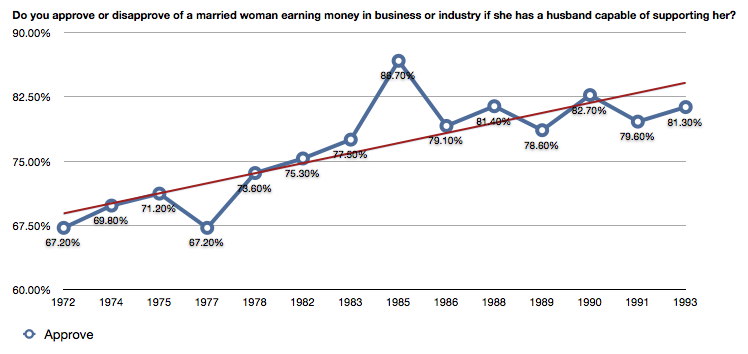
I have chosen to use Gender as the identity issue of the 1980's. I have chosen to do this because of how Gender roles changed between the early 70's and 1993 as seen in the table below.
 It is clear to see the gradual increase in approval of a Woman working in business or Industry if she had a Husband that was capable of supporting her. Ignore the end of 1985 though. I have no idea what happened.


Representations of Gender in Magazines
 "In the 1980s, magazines and advertisements increasingly started representing women working alongside men in business and industry, reflecting dominant values towards equality during this period. The magazine Working Mother is a good example of a publication that prominently featured these sort of representations. Although the magazine is filled with representations of women making macaroni and administering lice treatment, there are there are also a high proportion showing them taking an active role in business and industry." The progress can be seen as slow considering this was only 30 odd years ago but the rapid change of attitude is a positive. In films too, you could see the gradual shift in attitudes, as more Women worked in business or Industrial jobs. 

In the 1980s too, there was also some issues with Womens rights in terms of Abortions. There was a case between Harris and McRae. "On January 15, 1980, after 13 months of deliberation, Federal District Court Judge John F. Dooling Jr. invalidated the Hyde Amendment—federal restrictions on Medicaid funds for medically necessary abortions—as violating the First and Fifth Amendments. His decision documented the health impact of denying poor women abortions; the major religious traditions which support the conscientious choice of abortion; and the pervasively religious character of the anti-abortion position that the fertilized egg is equivalent to a person. The court’s holding required the federal government and all states to provide Medicaid reimbursement for all medically necessary abortions for indigent pregnant women." 
However, on the 30th of June 1980, a divided Supreme Court reversed the Judge's decision. This meant "ignoring his comprehensive findings of fact as well as the principle that the state must respect the constitutional rights of the poor in distributing or limiting welfare benefits." The court approved the elimination of Abortion from publicly funded healthcare programs even where a Woman's health was in danger or she was made pregnant by result of Rape or Incest. This shows that while it is a highy controversial topic today, it is nothing like it was in the 1980's. Not much has changed in terms of opposition but they seemed to be able to pass legislation that favoured Anti-Abortion groups easier than they can now, which can reflect on Public opinion of the time. There were many court cases that involved rights over Abortions in the 1980's. As well as Harris vs McRae, there was also; H.L vs Matheson, City of Akron vs Akron centre for Reproductive Health, Thornburgh vs American College of Obstetricians and Gynecologists, Planned Parenthood vs Casey and Webster vs Reproductive Health Services. Additionally, "The Silent Scream" (an Anti-Abortion video) was released in 1985 and the headquarters for the National Abortion Federation in DC was bombed in 1984.

 But there were many positives for Women in the 1980s. Geraldine Ferraro was the first female Democrat nominated for the VP position. In 81, Reagan nominated Sandra Day O'Connor to the US Supreme Court, followed in 93 by Ruth Bader Ginsburg. 
 This was a time of rapid change for Women. Being much more widely accepted into the workplace and acheiving higher positions was key while there was still some debate over Women's rights such as Abortion which even today is a touchy subject for many and a key political issue. While not much was solved in the 80's there was significant progress, which set the course for what it is like now, while still not perfect it has come a long way since the 80s and even further since the 50s. 

Resources
http://lessonbucket.com/vce-media/units-3-4/media-texts-and-societys-values/gender-in-1980s-america/
https://ccrjustice.org/home/what-we-do/our-cases/harris-v-mcrae 


LGBT representation in the 1980's


The negative representation of the LGBT community in the media.


GLAAD – The Gay and Lesbian Alliance Against Defamation

GLAAD’s first meeting was held on November 14th 1985, in response to the negative way the New York Post was covering the HIV and AIDS issue. Its first protest was against the New York Times editorial policy and GLAAD was successful in persuading the New York Times to change their policy to using the word ‘gay’ rather than using derogatory terms. This was just the beginning for GLAAD, as their influence spread and soon other media sources were changing their policies to be less homophobic.

As at this time the LGBT community were portrayed on screen in negative and misunderstood ways, which due to the entertainment industries influence on the public led to misconceptions about LGBT people and AIDS, which was prominent in the media at the time.  

GLAAD is still a prominent group today, as they work with the media to build support for the LGBT community. They also share stories from the LGBT community in Spanish in order to increase understanding and support for LGBT members in the Spanish speaking community. They also host the GLAAD media awards which honours different entertainment Medias for their accurate representations of the LGBT community and issues. Amongst their thirty awards are those such as, ‘Outstanding Film’ and ‘outstanding newspaper article’.

Without groups like GLAAD, there may not have been any change in the representation of LGBT individuals in the media. Which would have a negative impact on furthering the LGBT cause, as media plays a big part in public opinion. Changes to the media and their repetition of LGBT people may not be as big of an issue as it was in the 1980’s but GLAAD’s lasting legacy is the fact that media has become much more inclusive of LGBT people, stories, and entertainment since GLAAD’s creation in 1985.

This is not to say that the portrayal of the LGBT community is perfect today, as GLAAD produced a study which showed that of 102 major films in 2013, only 17 had any LGBT characters. And even then the majority of these characters were offensive representations. Yet compared to the 1980’s the current representation for LGBT people has greatly improved. As in the 1980’s gay characters were often marginal characters or comedic.

Sources:

Gay Culture in the 1980s

'The Sexual Revolution (the 1960s-1980s), also known as the time of sexual liberation marked a time,
that involved the rejection of typical gender roles. It was a social movement that challenged what individuals had previously seen as sexual norms' (Crooks, 2011)

Lesbian/Gay Freedom Day Poster, San Francisco, 1983


During the 1980's the overt cultural, social and political rise of the LGBT community was becoming a prevailing trend that everyone in the USA held a opinion influenced to create a perception upon 'gay cultural identity' . With cities such as San Francisco, expanding along and becoming the hub of west coast artistic, social and political liberalism the growing 'gay' community flourished. For many gay Americans living in areas such as San Francisco, the concept of 'identity' was clear cut as they could present and infuse themselves within a strong community that was active in fighting anti-discrimination laws and social sentiment. 

However, the open community that allowed one to express one's identity, in these areas (other rural conservative and traditional areas were mainly not places for thriving gay communities), they still were exposed to the equally expansive counter groups, who promoted anti-gay agendas and sought to influence at the highest levels to persecute and restrict homosexuals, both male and female, whether on religious lines, social ignorance, or their preconditioned ideologies, they strongly advocated [institutional] homophobia both mentally and physically.

For the homosexual individuals fighting against a social majority and sexual equality, the conditions that impacted them even to the point that they knew they could be murdered just for maintaining a same sex orientation. for example political activist and promoter of the LGBT community, Harvey Milk, San Francisco's first openly gay member of the Board of Supervisors, was murdered by Dan White in November, 1978. Fortunately, before his murder Milk helped mobilize gay and lesbian activists throughout the state to defeat anti-gay Proposition 6, a proposed piece of legislation that would prohibit teachers who were gay from working in California. The early 80's gay individuals maintained a social statue inferior to that of the ideal heterosexuals even the US Army, who had declared homosexuality to be “incompatible with military service” in 1982, (they were forced to admit in 1989 that gay recruits were just as good or better), however they were tolerated...Then AIDS happened.

Legacy of the discovery and ensuing pandemic of AIDS, decimated the gay community and the use of objective fledgling research, (which created a link between gays and AIDS) , by prominent public figures, both political and religious, made their anti-discriminatory rhetoric hard hitting and manipulated the spread of the disease to attack a minority group.inspires anti-gay crusaders like the Rev. Lou Sheldon, who will found the Traditional Values Coalition in 1981. Pat Buchanan, communications director for President Ronald Reagan, called AIDS, first identified in 1981, "nature's revenge on gay men.

GRIDS , (gay-related immune deficiency syndrome), which became the norm, attacked all homosexual and even those diagnosed who where straight though affiliation became a gay 'leper', the legacy of this side of the pandemic has been contemporary show in works like The Dallas Buyers Club (2013).


'gay men had to find ways of preserving gay identity and creating a community that could withstand the physical and psychological threats facing it' 
Des Harmon, The Culture of AIDS


Sources :
 Picture http://www.gayinthe80s.com/ 

Southern poverty law Center (2005) https://www.splcenter.org/fighting-hate/intelligence-report/2005/history-anti-gay-movement-1977

Crooks, R., & Baur, K. (2011). Our sexuality (11th ed.). Belmont, CA: The Sexual Revolution Wadsworth.http://historyofsexuality.umwblogs.org/mid-to-late-20th-century/the-sexual-revolution/
http://picturethis.museumca.org/timeline/reagan-years-1980s/gay-lesbian-rights/info 

The Sexual Revolution

   The Sexual Revolution

The Sexual Revolution (Also known as a time of Sexual Liberation) was a social movement during the late 60's and throughout to the end of the 80's that challenged the traditional views and actions regarding sexuality and relationships.  One of the defining aspects of the Sexual Revolution was the decriminalisation of homosexuality. Only three states decriminalised homosexuality during the 80's, this could be put down to the spread on the HIV virus (human immunodeficiency virus) and the link people made between HIV and Homosexuality. The virus was first called GRID (Gay-related immune deficiency) or Gay Cancer in 1982 however later that year it was changed to AIDS (acquired immune deficiency syndrome). The link between homosexuals and HIV was simply that the first patients that had HIV were 5 young gay men. It is obvious now that HIV can affect people of all sexualities yet in the 80's there was mass hysteria because of the unknown virus. 


Many viewed the virus send from God to punish the gay man for not following his word. in 1985 Paul cameron said that the aids crisis showed that "the extermination of homosexuals" might become necessary. and then in 1986 Colorado's Summit Ministriesl published "Special Report: AIDS." which blamed gay men for the epidemic and calls for a national crackdown on homosexuals. Before this Cameron was a professor at the University of Nebraska and started to publish pseudo-scientific pamphlets that stated that that gay people commit more serial murders, molest more children, and intentionally spread diseases.

The Gay community and activists would fight back, as they have been doing since the start of the 60's . Boston's Gay Community news wrote a tongue in cheek article that stated ""Tremble, Hetero Swine! We shall sodomize your sons, emblems of your feeble masculinity, of your shallow dreams and vulgar lives. We will raise vast private armies ... to defeat ... the family unit." however, Anti-gay groups viewed and used this article as proof of a "secret homosexual agenda."