Wednesday, 20 January 2016

Reagan, A Failure Yet Loved Like a Deity

I think this affection of Reagan is extremely odd as there have been 18 republican presidents and of that two have served after Reagan and many of these presidents unlike Reagan were not a complete failure as Conservatives. When reagan came to power he inherited a federal budget of $599 billion in revenue, $678 billion in spending, and a deficit of $79 billion. However once He left office the next president, George Bush, inherited a federal budget of $909 billion in revenue, a little less than $1.1 trillion in spending, and a deficit of $155 billion. So why is he viewed as the president that all should aspire to be like?

Reagan legacy is very similar to the UK's Margaret Thatcher. Many UK conservatives call for times to return to when she was in power. Ideological Soul mates Ronald Reagan and Margaret Thatcher were both in power of their respective countries during the 80's and together rekindled the special relationship between the United Kingdom and the United States of America. Their ideological similarities such as Limited Government, Low taxes and High Military spending and supporting a Free Market are some of the key principles that are still supported by a large amount of Conservatives in both countries. However the legacy of Reagan's specific style of republicanism that is often referred to as the ‘good old days’ by many republican’s who find the recent Obama office as ‘Anti-American’

Just type Reagan vs socialism and hundreds of Articles and Youtube videos on how Reagan 'Warned us about Obama'. Many of them state that Reagan's form of government reflects the view that the founding fathers had for America, that view being that the people should be free of the tyranny of the Government. 

Two videos show how conservatives still use Reagan as the prime example of how government should be run
This video shows a speech (albeit edited) by Reagan stating that to have socialism the government has to control the people. While this video https://www.youtube.com/watch?v=NEPPHjKIZps Is a documentary trailer that although is not based upon Reagan directly but shows 4 examples of him condemning big government. The film itself only really shows Obama vs Reagan in a very one-sided affair. 

I think this affection of Reagan is extremely odd as there have been 18 republican presidents and of that two have served after Reagan. Even when Reagan was a failure as a Conservative. His big thing is to limit the power of the government yet  Total federal-government employment rose between 1981 and 1989 from 4.9 million to 5.3 million.


Article -http://www.vanityfair.com/news/2015/01/ronald-reagan-policy-political-failure 

Icon of the 80's and Reaganomics

A huge icon of the 1980's is arcade games, possibly most notably Pac-Man which was first released on May 22,1980 in Japan and October 26, 1980 in North America. As with many of the new technologies in both the 1980's and contemporary culture, the game itself was written and produced in Asia. It is an entertaining thought that actually some of the most iconic 'American' objects actually did not and do not originate within the United States itself.

Pac-Man itself had a huge influence on American culture within the 1980's, as an example, Ronald Reagan supposedly sent a letter to a young boy congratulating him on setting a world record score of 6,131,940. This score has now been proven to be unachievable so the legitimacy of this is questionable but still possible.

Moreover it isn't simply that people had enjoyed playing Pac-Man but they loved it. The American people loved Pac-Man so much that by the end of the 1980's, the decade in which it was released, the game grossed over $1 billion in quarters. That was higher than the highest grossing film at the time, Star Wars.

There is perceived to be a 'golden-age' for arcade games, this is argued to have begun in 1979 and began its decline in 1983 and had ended within the next few years. It is believed that the release of Space Invaders really kickstarted the golden-age along with the release of the Vector Display, which was a new type of gaming display used in the arcade machines. This could be a possible reason for Pac-Man's popularity as it was released right in the middle of the arcade game boom.

Finally, the technology developments that went into producing the arcade games were all beneficial towards creating new technologies of which we see today. This is why it is easy to say that arcade games are a huge part of the 1980's American culture.

Image: http://cdn.wccftech.com/wp-content/uploads/2015/04/pacmaan.png
Pac-Man info: https://en.wikipedia.org/wiki/Pac-Man
Golden age: https://en.wikipedia.org/wiki/Golden_age_of_arcade_video_games


Moving on to President Ronald Reagan and Reaganomics. Reaganomics was one of the single worst economic policies of any Presidency to date. Okay, this a fairly biased view but I am far from the only person whom believes that to be true. The principle policies of Reaganomics consist of cutting taxes, less government spending, more military spending and deregulating domestic markets.

Reading a website named 'Truthout' it contains an article named 'Revisiting the Reagan Nightmare', the title shows both contemporary issues and issues that were perceived at the time. It is clear that Reagan had good intentions for the short run but he and his administration had in no way thought about the long term or post-Reagan. 


The article written by Terrance Heath, says "Though we will be inevitably awash in conservative praise and hagiography of Reagan, his 100th birthday is also an occasion to remember how America's long economic nightmare began". Here Heath blames Reagan for crippling American economics, which is true. Due to Reagan's tax cuts which at its highest point reach a huge cut of over $1 trillion and his increased spending on the military led to ballooning deficits. Where did the deficit go? The Federal Reserve Board, the principle agency in charge of controlling the American economy, sold the debt to China mostly. Under Reagan the United States went from being the signle largest creditor country in the world to the single largest debtor. This means that the U.S. went from being owed the most money by other countries to owing the most.

Reaganomics was quite frankly a poor economic policy. Unfortunately it left America in a terrible economic state which even today America has never fully recovered.

Truthout article: http://truth-out.org/archive/component/k2/item/94343:revisiting-the-reagan-nightmare

Reagan image 1: http://www.cps-news.com/wp-content/uploads/2010/06/Reaganomics-is-the-Problem-2.jpg
Reagan image 2: http://www.cps-news.com/wp-content/uploads/2010/06/Reaganomics-is-the-Problem-2.jpg

Reagan and the EPA


"Trees cause more pollution than automobiles do."

Yes, Reagan really said this in 1981.

The history between Reagan and the EPA is complicated and full of twists. While he was the Governor of California, he had a very good record with the EPA and other environmentalists. This changed once he got into the White House.

He is praised by some, including the Republicans for Environmental Protection, or REP, who after his passing in 2004 wrote "His wilderness protection achievements are an enduring legacy for the American People. President Reagan signed into Law 38 bills that added more than 10.6 million acres of spectacular forests, mountains, deserts and wetlands to the National Wilderness Preservation System." Even the LA Times released an article praising him for his work while the Governor. But when he got into the White House, his approach took a change for the worse.
"The Reagan administration adopted an extraordinarily aggressive policy of issuing leases for Oil, Gas and Coal development on tens of millions of acres of national lands." This was the polar opposite ot what Reagan had stood for when Governor of California. Some people believe that his position in California was purely political, to appeal to the pro-environmental movement that was in California at the time.

Also, over 20 high-level EPA employees were removed from their jobs during Reagan's first 3 years in Office. Additionally, several Agency officials resigned amidst a variety of charges, ranging from being unduly influenced by industry groups to rewarding or punishing employees based on their political beliefs. Sewergate was the largest scandal of the era for the EPA. This involved the targeted release of Superfund grants to enhance the election prospects of members of the Republican Party. There were also moves made by Reagan to weaken the Clean Water Act, which resulted in Reagan vetoing a reauthorisation of the act, although this was overwhelmingly overridden by Congress. Under Reagan's administration, the then Administrator of the EPA made a move to "gut the Clean Air Act with proposals to weaken pollution standards 'on everything from automobiles to furniture manufacturers.'" This took Congress 2 years to defeat. Not only was it Reagan that was unpopular with the EPA, it was most of his administration.

In its first budget proposal the administration "tried to cut EPA funding my more than 25%," and this is said to have set Solar back "a decade." Additionally, during the first year of his administration, there was a 79% decline in the number of enforcement cases filed from the regional offices to EPA headquarters as well as a 69% decline in the number of cases filed from the EPA to the Department of Justice.
So even today we are feeling some of the effects of Reagan and his stance on the Environment. It is easy to see why the EPA did not like Reagan or any of his administration, as they made many attempts to destroy that branch of the Government and focus on non-environmental issues, to put it diplomatically.

Reagan was also very nonchalant when it came to the problem of Acid Rain, that had been destroying Fish and Plant life in America and Canada for years. In 1981, he said to Prime Minister Trudeau that he would honour the agreement made by Carter which required vigorous regulation on Pollution levels. After 3 years of a lot of talking and not much action, the EPA wanted Reagan to make a major budget commitment to reducing the causes of Acid Rain. However, the proposal was deemed "wasteful" by Reagan and his administration and thusly was rejected. He went on to question the scientific evidence on the causes of Acid Rain and was reluctant to impose additional restrictions on the industry.

Reagan did a lot to annoy the EPA and other environmentalists. He changed his view because of Politics and showed his true colours more so than any President has changed their behaviour at any point in History.
Few groups had more of a reason to hate him, due to his blatant disregard for the Environment. This is why I decided to use the EPA as an example of Reagan hatred, as trying to destroy them and go against everything that they stand for gives people a bad impression of what your views are on the Environment.


Resources
http://grist.org/article/griscom-reagan/  
A Look back at Reagan's Enviromental Record.

http://www.ontheissues.org/Celeb/Ronald_Reagan_Environment.htm
Ronald Reagan on the Environment.

Tuesday, 19 January 2016

African-American Hatred of Reagan


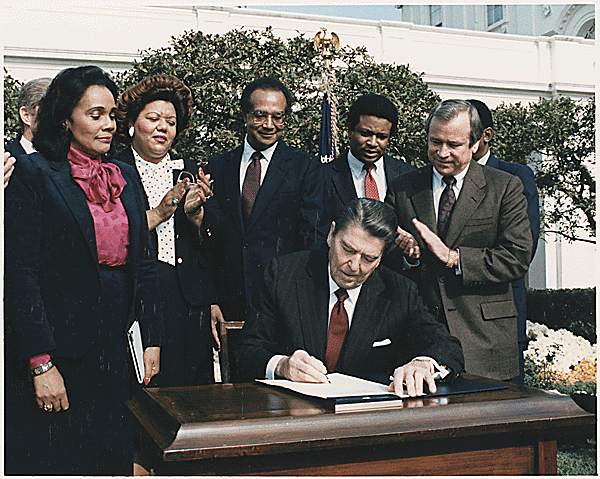
President Ronald Reagan signs the bill making Martin Luther King Jr.'s birthday into a national holiday, as Coretta Scott King watches, Nov. 2, 1983, ...
The Reagan administration of the 1980's, which promoted neoconservative, Republican policies of reduced government, greater state governance, tax reduction and development of the (capitalist orientated) middle-class, earned him strong opposition from various sects who  openly criticized his actions as President. One of the core minority groups who became actively discontent with the social impacts of 'tickle down Reaganomics' and the progressive removal of access and opportunity to welfare programs where where those of the African-American community.  In Ehrman and Flamms book 'Debating the Reagan Presidency, they present the view that African-American preconditions to that of the Reagan era to "have made tremendous economic progress (since 1960); first end of legalized discrimination, then increased demand for black workers created through affirmative action creating wage increase and thus a substantial middle class.", thus the impact of Reagan on this minority group was fundamental in shaping the political and socio-economic condition  of the period.

Reagan induced hatred from African-Americans, primarily because they did not receive the same economic benefits of Reagan high level of investment and leniency for corporations and promotion on the wealthy and middle class, whom maintained a low number of African-Americans. Many Blacks were in positions of limited financial stability and relied strongly on the limited, yet available welfare programs, such as food stamps, job-training programs and employment in government funded public sector work, these programs came under pressure as the administration reduced the budgets in an attempts to maintain a working Federal budget, especially after the enacting of corporate tax-reductions and increased private sector spending (i.e Reaganomics). This presented a variety of conditions that many of those who had fought for equal rights in the 1960's (such as the progression of equal employable and reduction of discrimination in employment), that where deemed unacceptable.

 Reagan as a conservative Republican President, could not align any part of his ideology of that with African-Americans, who although. Although not overtly opposed to equal rights, Reagan maintained a limited promotion policy on affirmative action, as he and his cabinet viewed it as a means of creating a 'noncompetitive marketplace atmosphere', plus political promotion would have placed some of his WASP supporters in positions of racial and class alienation. Further, was the presentation of his administration to work with black activist in federal issues, such as his initial position not to support a national holiday symbolic to the equal rights movement. Or extending the condition of the 1964 Voting Rights Act, during its 1982 renewal. In both events there was a reversal of this initial position, reversals which where strongly criticized and aggravated by the media, gaining him 9% of the black vote in 1984, and further breaching the gap between traditional Democratic and Republican voters.


Sources:
John Ehrman, Michael W. Flamm Debating the Reagan Presidency, pg. 47

Earl Ofari Hutchinson, Ronald Reagan Was No Friend To Blacks  
http://newamericamedia.org/2011/01/ronald-reagan-was-no-friend-to-blacks.php 

(Pictures) , Reagan enacting Martin Luther King Jr. Day (1983)
http://beaseedforchange.org/page/2/  


Saturday, 16 January 2016

1980's Iconic


It is widely believed that HIV originated in Kinshasa, in the Democratic Republic of Congo around 1920 when HIV crossed species from chimpanzees to humans. Up until the 1980s, we do not know how many people developed HIV or AIDS. HIV was unknown and transmission was not accompanied by noticeable signs or symptoms.
While sporadic cases of AIDS were documented prior to 1970, available data suggests that the current epidemic started in the mid- to late 1970s. By 1980, HIV may have already spread to five continents (North America, South America, Europe, Africa and Australia). In this period, between 100,000 and 300,000 people could have already been infected. 

In the mid 1980s, there was intense media focus on this new and frightening disease with no known cure. Victims were often viewed as falling into two groups: haemophiliacs who were often labelled 'innocent victims', and gay men and drug users, who were frequently referred to as 'authors of their own misfortune'. 

Throughout the 1980's these disease was known as gay flu, and as such put large amounts of the media and public attention on the gay community, leading to further and wider spread homophobia in the united states. This led to Aids/HIV being seen as a gay problem and thus received little to no government funding for a cure in the early years. But as time moved on it became apparent that the disease affected all sexualities and drug close to a cure was discovered in 1989. 

Even though Aids/HIV is almost a livable condition it still claims thousands of lives a year Africa, with the lack of finance means if you are born on the continent you have a 1-6 chance of being born with the virus.  

Friday, 15 January 2016

Ronald Reagan


Ronald Reagan: Hatred

This image suggests that many people were much better off when Reagan was not in power. Despite Reagan being seen as a great American President, as he represented the American Dream, he was not liked by all Americans. This is for a number of reasons, including, his political views. He believed that the 'trickle down system' would work- meaning that the wealth of the very few, would make its way to the poorest of Americans. However, not only did this not work, but Ronald Reagan also believed that "the U.S. economic pie should be enlarged, not that everyone should receive an equal slice". This reinforces the notion that although Reagan wanted better things for the United States, he did not believe in welfare or helping the poorest of Americans. The image confirms this, because the it is saying that during Ronald Reagan's presidency, the family were living in poverty throughout the 8 years Reagan was in power. This is a long time to be in poverty, especially when 'the trickle down system' was supposed to be beneficial for the majority of Americans who were not wealthy. This image not only indicates hatred for Ronald Reagan, but also highlights many flaws of his presidency too.

The image is not from an 80's viewpoint because it is comparing the past (during Ronald Reagan's presidency) and the present, (which is 2013, when the image was  published). This is interesting because the image highlights that when a Republican president was in power, poor Americans were worse off. Whereas, in 2013, Obama (a democrat) was in power, which the image suggests is when the poorest of Americans were much better off financially. This reinforces the image being an example of hatred rather than hagiography.

https://www.youtube.com/watch?v=O164HT5U8Rw (Video from the image)

This YouTube video is really interesting because it has a number of images with facts about Ronald Reagan's presidency. A key theme throughout is proving how much Ronald Reagan was hated and how little he actually did for the majority of Americans. He was a president who was only interested in the very few wealthy, thus why the image above has a negative viewpoint on Ronald Reagan and his presidency. The title of the video states "Ronald Reagan The Worst President Ever". This proves that the image is an example of hatred, rather than of hagiography.

Reaganomics:
This was the economic policies that were promoted during the 1980's. In theory, this was suppose to be a positive thing for all Americans. It included tax cuts, and cutting government spending. However, Ronald Reagan focused on cutting taxes for the richest Americans, despite being in a recession. This is known as the "trickle down economics", the idea of cutting taxes of the most richest Americans, so they have more money, therefore, they have more money to spend and invest. This would then benefit the poor, because of the notion that the money of the most richest Americans, would then trickle down to everyone else. So to the wealthy Americans, Ronald Reagan was seen as a hagiography president, because they benefited hugely during his presidency. But on the other hand, the rest of the country were not better off financially, and some were even worse off, therefore Reagan was seen as a president who was hated by many.

Grace La Traille

Sources: https://www.google.co.uk/search?q=ronald+reagan&biw=1366&bih=673&source=lnms&tbm=isch&sa=X&ved=0ahUKEwiGxtrPwKvKAhVKExoKHSkZDukQ_AUIBigB#tbm=isch&q=ronald+reagan+seen+as+bad&imgrc=CvK106xUucarsM%3A 
http://www.ontheissues.org/Celeb/Ronald_Reagan_Welfare_+_Poverty.htm
https://www.whitehouse.gov/administration/eop/cea/economic-report-of-the-President/2013
http://www.ushistory.org/us/59b.asp
https://www.youtube.com/watch?v=z5CCRI1vdwE 

Thursday, 14 January 2016

Iconic 80's image - Fashion from musical influence


Who doesn't think of fashion when they think of the 80's?

The 80's could arguably be considered to be one of the most iconic era's in fashion history. It was a decade that changed the fashion industry and pushed boundaries to the max. I was torn between choosing 80's fashion and 80's music but in reality, the two go hand in hand. Fashion influenced music and music influenced fashion so it's hard to talk about the one without the other.
From hippies, 'flower-power' and flares in the 70's, the dramatic change into the next decade is one that will never be forgotten. Fancy dress became acceptable as day wear, leg warmers were worn outside of the gym, big hair and men wearing make up became culturally acceptable. These fashion statements and more, which would have once been frowned upon and dismissed, became the 'norm' for people everywhere. Of course, none of this would have been possible without all of the quirky/weird/different and brave musical influences that America had to offer.

The most famous of all influences would have to include Madonna - the queen of 80's music and fashion. She created bold statements and pushed limits with regards to her style and her music. Her creativity and reinvention of her sense of style is one that has influenced thousands. Her iconic hairbands, chunky bangles and over the top necklaces created new trends all over the world. But remarkably, once she had conquered one fashion image, she would quickly create the next set of statements in a completely different way. Her sense of style was always noted with praise and with each change of outfit came a change of musical style.
If not Madonna, then Boy George most definitely made in imprint in the fashion world. It was one thing for a women to dress a bit more crazy and wear daring make up, but when Boy George came on the scene there was a whole new uproar of opinions. It was his sense of style that initially paved his way into the music industry, taking the 80's by storm. His outrages outfits were one thing, but his use of make up and openly crossdressing was something that was harder for some people to accept, but thankfully they did and he earned his well deserved place in the 80s fashion market. With that being said, whilst the younger generations thought his new out-there style and influence was incredible, the older generations had yet to be convinced, but regardless to that the bars that he set with 80s fashion were unreachable, and while many came close, I personally can't think of any one nearly as fashionably influential as Boy George.


No-one can think of the 80's and not be drawn to the crazy dress sense that was taking over the nation. These artists (and more) shaped the 80's in a way that no other decade has managed to do, while yes, each decade has its own unique fashion style that everyone easily recognises, none do it as well as the 80's. 
80's fashion didn't just change it's own decade, it continued to influence the 90's, 00's as well as the current fashion/music industry today. Purely iconic to the era and a statement that should not be forgotten.