Friday, 12 February 2016
Fast Times at Ridgemont High
[Error:</AM2407blog\>{filetrace:Lauren>Docs>AmStudies>AM2407blog}<lost>]

Thursday, 11 February 2016
(Week 5) ALF (1986-1990)
Summary
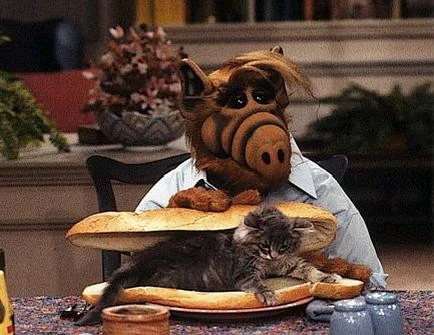
ALF standing for (Alien Life Form) crash lands his spaceship into a suburban garage, and it is damages beyond repair. ALF himself is smart mouthed and has a bad attitude. The family take him in and the show really seems to revolve around his interpretation of mankind, while throwing in the occasional oddity of him attempting to eat a cat.
What does he say of 1980s America
ALF himself says a lot about the 1980s. The whole fascination surrounding Aliens and conspiracies of aliens on earth was no less prominent in the 1980s to how it is now. ALF is a tv representation of peoples doubts and ideas surrounding alien life form on earth. In a way this is no different from the movie 'Paul' where a judgemental, bad mouthed little alien avoids unwanted attention and sits back a judges the human race while on earth.
ALF (Animal Liberation Front)
When searching through the internet for information on ALF the tv shows, i constantly came across this group of activists from the 1980s. The group was organised and has roots back to 1963 but it was the 80s where the group were in full swing and began to spread throughout Europe.
- ALF released footage which showed primate researchers laughing and joking at a baboon, as they inflicted brain damage as part of research project into head injuries caused by accidents.
Although this has nothing specifically to do with the tv show, the name ALF may have been given to the character to highlight the groups success and growth in the 1980s. It just seems too much of a coincidence not to have some sort of relation.
ALF is also a figure of how the desirable life style of the 1980s, may not be as desirable as people would like to think. We already know that the Yuppie lifestyle was sort after in the 1980s and the dream of suburbia, but ALF is an example of how it is not as dreamy and flawless as people may think. He is constantly causing trouble for the family and is almost just an uncontrollable baby. The show still represents the suburban life style that was so popular to people in the 1980s, but it does it in a way that suggests it may nto be all it cracked up to be.
ALF sets up the ideal 1980s family, a dad that goes to the office, a stay at home wife and a son. ALf was popular amongst people because it spoke out to peoples desires of how they should live, but with a comic edge. However all of the points I have made above may not be a serious and as accurate a representation of the 1980s as the show is a comedy and should not be taken as having too serious meanings.
No matter what ALF suggests, be that alien intervention on earth, a secret link with a radical animal rights group that spread to Europe in the 80s or another representation of the suburban life style in the 80s, it must have been popular to the audience of the 80s as even though it only ran for four years 1986-1990, a movie was made in 1996 of the same little alien.
Wednesday, 10 February 2016
The Blues Brothers (1980)

The Blues Brothers (1980) , is considered as a 'Cult Classic'. It is set in Chicago, during the point of the social and economic collapse of the city in the Reagan era, The story depicts two brothers, Jake and Elwood, who are (upon Jake' release from 'the County Jail' ), Embark on a journey of obtaining fame and finance (a comical $5000, bid to save their childhood housing project), The film projects the urban environment, and all the racial and social-economic problems of the time, i.e. Failed (religiously supported) welfare, post incarceration, employment for the under classes. The reason why this film is so fundamental to the ear of the 1980's, was because of the class undertones portrayed between those of the 'working class' and the hierarchical society,
The 'band' being comprised of individuals who are involved in typical 'average joe' jobs , who renounce their occupations in pursuit of a an occupancy that although pays less is, in a orientation with their specific dreams and desire. The film is very present in showing the povertish side of urban living, such as Jake and Elwood living next to a rail-line and surviving off gas cooked toast.
Within the context of the film, several key social phenomenon, such as (satirical) racism, which is shown though 'the fucking Illinois Nazi' which shows there is some residual anti-Semitic (and minority group), Black 'ghetto' culture (i.e urban chicken shop) , and the social insecurities of the aggressive upper class, through the representation of the bar owner and manger.
Overall the movie presents a comical version of the era but also shows how the conditions of social, economic and political pressure that were a constant issue or metropolitan culture
Representation of AIDS/gay community in 'An Early Frost' 1985.

'An Early frost' - Gay representation/representation of AIDS in 1980's film and TV
'An Early Frost' was a TV movie aired on 11th November 1985, and was viewed by 34 million people and nominated for fourteen Emmy Awards (and won four).
'An Early Frost' is
about a successful lawyer who is forced to come out to his family after his partner
cheats on him and transmits AIDS to him. The main character Michael Pierson’s
family react in different ways. His father (Nick) at first refuses to talk to
his son as he no longer knows who his son is. Michael’s mother (Kate) tries to
be supportive by trying to get the rest of the family to accept Michael. As she
has read an article about AIDs and knows it can’t be transmitted through casual
contact. However, Michaels sister Susan is pregnant and refuses to see Michael
as she “can’t take that chance” of AIDs being transmitted to her, her son or
her unborn baby. And at one point she physically stops her son from hugging
Michael.
The film focusses on a white gay male perspective, and reaffirms the stereotypes of the origin of AIDS, that it was gay men that were first infected. The film also tries to send a message that monogamous relationships are preferred over the alternatives. As Michael only contracted AIDS because his partner cheated on him, the film tries to gain the viewers sympathy for the main character by emphasising this monogamous relationship. Which gives an insight into the 1980’s views about casual relationships, especially regarding the gay community.
This film shows the stigma attached to AIDS as Michael is in
a hospital room at the beginning of the film with an ‘Isolation’ sign on the
door, and members of the hospital staff refuse to tend to Michael because he
has been diagnosed with AIDS. Later in the film Michael needs to be taken to
the hospital after being found unconscious, however the paramedics refuse to
transport him to the hospital when they find out he has AIDS. As well as this,
when another man (Victor) in the same hospital as Michael dies due to AIDS we
see the doctor wearing a face mask and disposing of Victor’s personal
belongings because it was thought they might spread AIDS. All of these
different things in the film show how the even the medical community thought of
AIDS in such a misinformed way at this time.
Compared to later films about AIDS, ‘An Early Frost’ offers
quite a good representation of gay people. Michael and his partner Peter are
shown kissing, although this is because they needed to be shown as partners and
not just friends. However in the 1993 film ‘Philadelphia’ the two main
characters are obviously partners but there is never any indication that they have
a sexual relationship. So compared to this ‘An Early Frost’ at least shows a
more normal gay couple.
The commercial film industry at this time wanted to make
films about AIDS whilst avoiding making films about homosexuality. Such as ‘An
Early Frost’, where NBC had the producer’s spend two years developing this film
and rewriting the script until NBC found it acceptable to air, as they didn't
want it to be too much about the gay community.
Therefore, this film gives us insight into the
representation of people with AIDS and this film deals with the issues around
misinformation about AIDS and highlights the 1980’s stigma towards gay men.
Sources:
The AIDS Movie: Representing a Pandemic in Film and
Television
Queer Representation, Visibility, and Race in American Film
and Television: Screening the Closet
The Wizard
 The Wizard (1989)
Trailer: https://www.youtube.com/watch?v=ls4mrIjqyH8
Released in 1989 The Wizard tells a tale of two brothers, Corey and Jimmy, who want to run away to California and a girl called Haley, who's on her way home to Reno. They realise they have no money to get to California yet find out that Jimmy is great at video games, he gets nicknamed 'The Wizard' and aim to be contestants on a show called "Video Armageddon" where they can win a prize of $50,000.
The film's plot wasn't the only thing that turned off movie critics as many saw the film as a 90 minutes advert for Nintendo, a view that is very much backed up by the shameless references to Nintendo games and Nintendo accessories.
 The Power Glove is an excellent example of this. Released at a similar time to the film, The Power Glove was meant to innovate the way that people played video games. The antagonist of the film used one and said the famous quote "I love the Power Glove. It's so bad"
The film became a cult classic and although failed at the box office it opened up a new genre to the silver screen. Films such as Tron (1982) before it obviously had video games in it yet The Wizard was given full licence by Nintendo and led to more developers to dip into the world of Film such as the Mortal Kombat franchise and more recently the Resident Evil films.
For representation of the 1980's I feel that the whole theme of Video Games is very iconic of the 1980's. Computers and home video gaming consoles started to thrive in the 1980's and it becomes apparent during the latter years of the decade with the emergence of giants such as Nintendo and Sega. The market was becoming far more competitive and more advance the previously. The film itself was used to introduce one of the best selling games of all time and arguably the greatest game of all time "Super Mario 3"to the western world and was released in North America a year after the film in 1990. The economic power of the Gaming industry was tested in 1893 when there was a crash of the industry. Before this point $3 billion were spent on home gaming consoles and three years later the industry fell to only $100 million. At the point of the release of The Wizard the industry was stood at a high of $5 billion in North America alone and since then has grown ever since
Although the Wizard was a terrible film with a terrible gross it does help us understand how important gaming was in the 1980's
Sources
http://www.minyanville.com/businessmarkets/articles/the-Super-nintendo-power-product/11/5/2008/id/19760?refresh=1
http://mentalfloss.com/article/29101/wizard-power-glove-and-children-peril
Back to the Future franchise

The Back to the Future films shows that in the 1980's there was a focus on the future. It was a time of rapid technological advancement and with this came an idea of what the future could be like, such as Hoverboards. It combines elements that have now become synonymous with the 80s, such as the DeLorean.
With more of a focus on the sequel from 1989 because it includes only last year, the technology that was proposed in the film franchise has been attempted to have been made. In October of 2015, Nike introduced a shoe with self-tying laces, shown on Jimmy Kimmel with Michael J Fox.
Additionally, there is also a hoverboard, as shown by the Tony Hawk video.
The fashion of the characters and the music as well gives a very "nostalgic" look back at the 1980s. From the theme song to the behaviour of the characters, it's all very 80s. Which is a reason why many people still love the film today, and it's adored by those who grew up watching the films as a teenager.
In the Independent article, it makes the point that it gave teenagers that were "terrified by the prospect of Nuclear holocaust at the time that it was OK, they would still be able to fall in love in future."
The film franchise as a whole, however, demonstrates that the 80s was a time when people were both looking forwards as well as backwards. Back at the Cold War, the history and still looming threat of nuclear destruction, but forwards to the 2000's, to a potentially better future, one with Hoverboards and self-tying shoes. It was a time of optimism, and in 89, they were free of Reagan (although dealing with Bush) so there was a reason to be optimistic. We may look back at them now and think that they are cheesy, or cliche, but it's amazing how accurate they have been with some of the predictions.
As a representation of the 80s the franchise works well, both as a form of nostalgia, showing how good they were, and a cliche. This shows that these films are to many people born later, what we imagine the 80s to have been like. The music is still played today, not because people want to be in the 80s, but because the songs have managed to remain popular.
http://news.nike.com/news/nike-mag-2015 - Picture of the shoes
https://www.youtube.com/watch?v=F1Kazbz_3Hw - Jimmy Kimmel
https://www.youtube.com/watch?v=Yn2pjkxxkt8&feature=youtu.be&t=17 POP TV Nike Shoes.
https://www.youtube.com/watch?v=wCZiEtduSQg - Tony Hawk.
https://www.youtube.com/watch?v=yosuvf7Unmg - Back to the Future Trailer
https://www.youtube.com/watch?v=MdENmefJRpw - Back to the Future II Trailer
http://filmschoolrejects.com/features/why-we-love-back-to-the-future.php
http://www.independent.co.uk/arts-entertainment/films/features/back-to-the-future-day-what-did-the-1980s-sci-fi-classic-get-right-about-the-future-we-now-live-in-a6698396.html
Gender representations/The Cosby Show (week 4)

The Cosby Show was an American sitcom which stared Bill Cosby. The show aired on September 20th, 1984.
For as long as televisions sets have existed, and even still today television shows and film still sustain to portray traditional gender stereotypes at the home, at the work place and social situations. Yes, there have been a number of films and tv shows during the 80s which have challenged the roles, yet stereotypical roles were still presented as the "norm". The Cosby Show did an incredible way of challenging these idealistic roles, audaciously going against the authoritative social values which were held during it's time period. The show redefined the portrayal of men and women within tv, in all aspects of expectations and responsibilities.
 Cosby's character, Cliff is shown to be as equally involved as his wife Clair, when regarding domestic duties such as cooking for his family, cleaning the house, and looking after the children. Throughout the series Cliff demonstrates his equal role in raising their children as well as dealing with their emotional and physical problems and needs. Both parents also have very respectable jobs in the show. It would have been more common at the time, in family-related texts, typically for the mother to take care of the housework, do the cooking, raise and look after the family whilst the husband spent the day at work.
 This series gives a great example of how challenged gender roles are not something to be feared or argued against. There should not be a "woman's role" or a "man's role" when considering house work and family responsibilities. Obviously whether or not women and men in real life chose to follow traditional or non-traditional roles is completely up to the individual, there should not be a right or wrong way. The show showcases how reversed gender roles and equality in gender roles within society and the home just as acceptable as the traditional roles we see daily.
Shows as The Cosby Show, along with many other films and tv shows which portray family's with non-traditional gender roles, and challenge the typical husband and wife behaviours have undeniably helped to loosen the boundaries which society had created for men and women.
In addition to breaking the gender boundaries in the 80s, The Cosby Show also took typical African-American roles in tv and film into new levels. The idea of an 80s tv show situated around the lives of a middle-class African-American family would have been a hugely positive leap for the African-American community. Up until then, African-Americans had more often than not, been limited to the roles of gangsters, pimps, drug dealers or a range of servitude. Whilst there was a small number of African-American based texts around, none succeed as well as The Cosby Show, which leaded to the growth of African-American texts in which it's characters would be perceived in a positive light, such as The Fresh Prince of Bel Air, Family Matters, Everybody Hates Chris and countless more.
Sources
- http://preserve.lehigh.edu/cgi/viewcontent.cgi?article=1821&context=etd
- http://www.studymode.com/essays/The-Cosby-Show-Challenging-Gender-Ideals-49308.html
- http://www.bbc.com/culture/story/20140919-was-the-cosby-show-revolutionary
- http://uk.complex.com/pop-culture/NaN/Invalid%20date/best-black-sitcoms/fat-albert-and-the-cosby-kids
Subscribe to:
Posts (Atom)